

What Blocks Shipping? The Delivery Failures to Fix
What blocks shipping is rarely engineering capacity alone. Find the decision, backlog, quality, and release failures that keep product teams stuck daily.

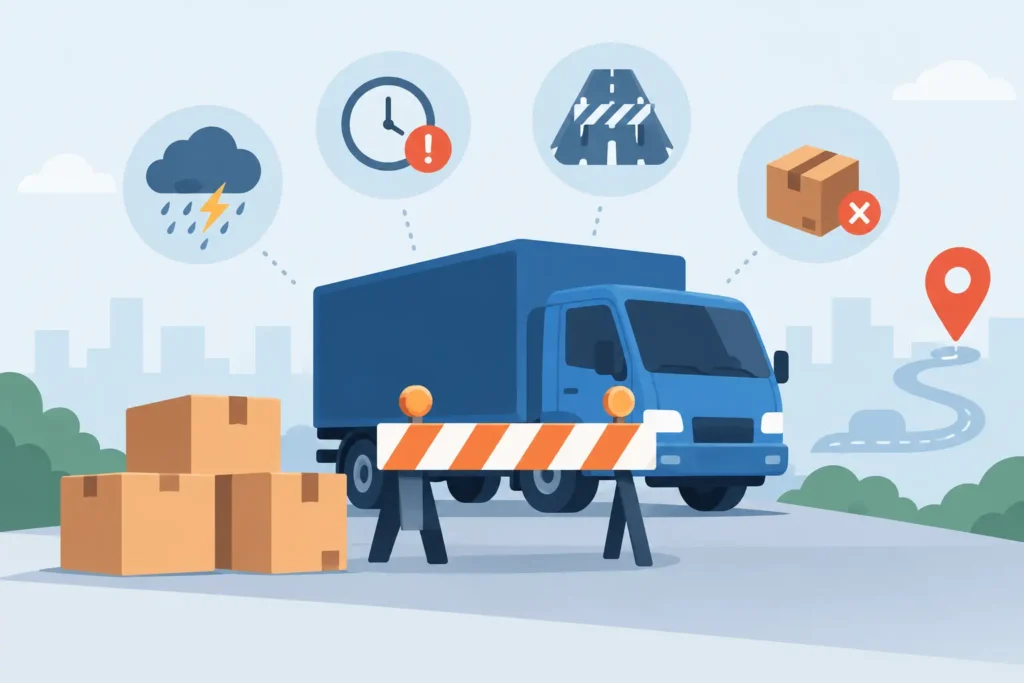
A roadmap can show a release date, a confident owner, and a set of features that appear nearly complete. Then the date moves again. What blocks shipping is usually not a lack of effort or a single engineering problem. It is work entering delivery without decisions, boundaries, acceptance criteria, or a credible path through release.
That distinction matters. When leaders diagnose missed releases as a capacity issue, they often add people, meetings, or status reporting. The team becomes busier while the underlying blockage remains. Predictable delivery starts by finding where work stops moving and assigning an owner to remove that constraint.
What blocks shipping in product teams
Shipping is a chain of decisions, not the final act of deploying code. Product, design, engineering, QA, security, legal, commercial teams, and operational partners all contribute constraints. A release slows when one part of that chain is unclear, late, or treated as somebody else's problem.
The recurring causes are familiar: a backlog contains too many competing priorities; requirements describe intent but not behavior; a stakeholder decision is waiting in an inbox; QA receives a feature without testable acceptance criteria; or a release depends on a payment provider, content approval, market configuration, or compliance review that was not planned early enough.
These are delivery system failures. They cannot be solved by telling people to move faster.
The backlog is a collection, not a commitment
A large backlog is not automatically a healthy backlog. In many teams, it is a holding area for ideas, executive requests, customer escalation items, technical work, and half-defined initiatives. Everything has an apparent priority. Nothing has a defensible order.
Engineering then starts work based on the loudest conversation, the easiest ticket, or an assumption about what leadership wants. Context switching increases, partially completed work accumulates, and the release plan becomes an optimistic interpretation rather than a commitment.
A useful delivery backlog answers harder questions: What outcome does this work support? Why is it more important than the next item? What must be true before development starts? What can wait? If those answers are unavailable, the work is not ready for a sprint or a release forecast.
This does not mean every item needs a long specification. It means the Product Owner or product lead has made the trade-off explicit. For an affiliate product, that may mean choosing whether a revenue-impacting tracking fix comes before a new publisher workflow. For a regulated casino platform, it may mean confirming whether a market-specific compliance change overrides a conversion experiment. The team should not be left to arbitrate that conflict through implementation choices.
Decisions have no named owner
Teams often call this stakeholder alignment. The practical issue is simpler: a decision is needed, and nobody knows who must make it by when.
A design can be finished while commercial approval is missing. An engineer can complete an integration while a security review has no scheduled reviewer. A launch can be technically ready while leadership has not decided which market goes first. Each group may be working responsibly, yet the release still stops.
Decision logs sound administrative until a release depends on one. A lightweight record should state the decision, the owner, the deadline, the options considered, and the consequence of no decision. It turns a vague blocker into an operational commitment.
Escalation also needs discipline. Escalating every question creates noise and trains leaders to ignore it. Escalating a decision that threatens a stated release date is appropriate. The owner should present the recommendation, the trade-off, and the latest date the decision can safely wait. That is far more useful than reporting that a team is “blocked.”
Requirements that look ready but are not
A ticket can be detailed and still be unready. The usual warning sign is a requirement that describes a solution without defining the behavior, rules, edge cases, or evidence of success.
Consider a request to “add localized checkout messaging.” Which markets? Which languages? What happens when content is unavailable? Who owns translations? Does the change affect legal disclosures, SEO, or payment conversion tracking? Can the message be changed without a deployment? If these questions emerge after development begins, the work expands inside the sprint and the estimate becomes irrelevant.
The answer is not documentation for its own sake. It is a working definition of ready that fits the team and the risk level. A small interface change may need a clear user outcome, acceptance criteria, and a design reference. A payment, identity, or regulatory change may also need nonfunctional requirements, dependency confirmation, rollback expectations, and sign-off owners.
Good refinement is a risk-reduction activity. Product brings the business context and priority. Engineering exposes technical uncertainty. QA identifies what can fail and how it will be verified. Design clarifies interactions. The point is not consensus on every detail. The point is to prevent known uncertainty from being disguised as a delivery commitment.
Estimates are treated as promises
Estimates become unreliable when teams are asked for certainty before the work is understood. They also fail when discovery, dependencies, review cycles, and release tasks are excluded from the estimate because they are inconvenient to discuss.
A forecast should separate known implementation work from meaningful uncertainty. If a supplier API has incomplete documentation, say so. If a data migration requires production validation, say so. If the work depends on a decision outside the delivery team, put that dependency in the plan rather than burying it in a ticket.
There is a trade-off here. Excessive analysis delays learning. But pretending uncertainty does not exist only delays it until the most expensive moment. The right level of discovery depends on reversibility. A low-risk experiment can ship with tighter feedback loops. A change that affects player eligibility, payments, or customer data deserves more preparation before a date is announced.
Quality arrives at the end
When QA is positioned as the final gate, defects become a surprise instead of a delivery signal. The team has already invested the time. Stakeholders are expecting a release. Pressure rises to accept known risk, defer testing, or classify broken behavior as a follow-up.
That pattern creates unreliable releases and erodes trust between product, engineering, and QA. It also makes every future estimate worse because the cost of rework is hidden across several sprints.
Quality needs to be designed into the delivery flow. Acceptance criteria should be testable. QA should see upcoming work early enough to challenge assumptions and prepare coverage. Teams should agree on what “done” means, including code review, testing, analytics, documentation, feature flags, monitoring, and any required operational approval.
The definition does not need to be identical for every item. A content update should not carry the same release burden as a new authentication flow. But exceptions should be deliberate and visible. If a team chooses to ship a limited version to meet a commercial date, document what is excluded, what risk remains, who accepted it, and how the follow-up will be tracked.
The release process is discovered too late
A feature can be complete in a staging environment and still be far from shippable. Production access, release windows, app-store review, vendor configuration, customer support preparation, marketing copy, market approvals, and monitoring all sit outside the narrow act of coding.
This is especially common in multi-market products. A global event brand may need coordinated content, localization, and traffic planning. A gaming platform may require jurisdiction-specific configuration and compliance evidence. A platform rollout may depend on customer communication and account-team readiness. Calling these “nontechnical details” does not make them optional.
Treat release readiness as part of the plan from the first meaningful scope discussion. For material releases, assign a release owner and make the checklist proportionate to the risk. Review it before development is finished, not on the morning of launch. That creates time to resolve gaps without converting every release into an emergency.
How to find the real constraint
Start with the last three releases that slipped, narrowed in scope, or caused avoidable follow-up work. Do not ask for a generic retrospective on team performance. Trace each release from request to production and identify the point where it waited.
Look for repeated wait states: pending clarification, pending approval, pending environment access, pending test data, pending vendor response, or pending release confirmation. Then distinguish between a one-off incident and a recurring operating pattern. A single failed deployment is different from a release process that has no accountable owner.
For each recurring pattern, make one operational change. Rank the backlog before commitment. Name the decision owner. Add a dependency review to refinement. Bring QA into planning. Define release readiness before development closes. Avoid launching a broad transformation program when a specific rule, role, or cadence will remove the current constraint.
This is where an embedded senior product or delivery lead earns trust. The work is not to create more process. It is to make commitments credible, surface trade-offs early, and keep the next decision from becoming somebody else's hidden blocker.
The next time a release slips, resist the easy answer that the team needs to work harder. Ask where the work waited, who could have moved it, and what signal arrived too late. Fix that part of the system before the next roadmap promise is made.
Written by Veljko Barnić
Product Owner and delivery consultant in Belgrade. Six years leading end-to-end delivery for affiliate and iGaming platforms, and open to Head of Product, Head of Delivery and senior product roles.
More on delivery

Fractional Product Owner vs Consultant Explained
Compare a fractional product owner vs consultant to identify the support your team needs for backlog control, decisions, delivery cadence, and releases.
Read the article
How to Reduce Product Rework Without Slowing Delivery
Learn how to reduce product rework by fixing unclear decisions, weak discovery, and release gaps before they turn into expensive delivery churn at scale.
Read the article
When Fractional Product Services Actually Work
Fractional product services give stalled teams senior ownership, clear priorities, accountable decisions, and reliable releases without a full-time hire.
Read the articleSomething isn't shipping. Let's find out why.
Send me three sentences about what's stuck, or take the free 30-minute call. Either way you'll get an honest read - including if the answer is that you don't need me.