

How to Reduce Product Rework Without Slowing Delivery
Learn how to reduce product rework by fixing unclear decisions, weak discovery, and release gaps before they turn into expensive delivery churn at scale.

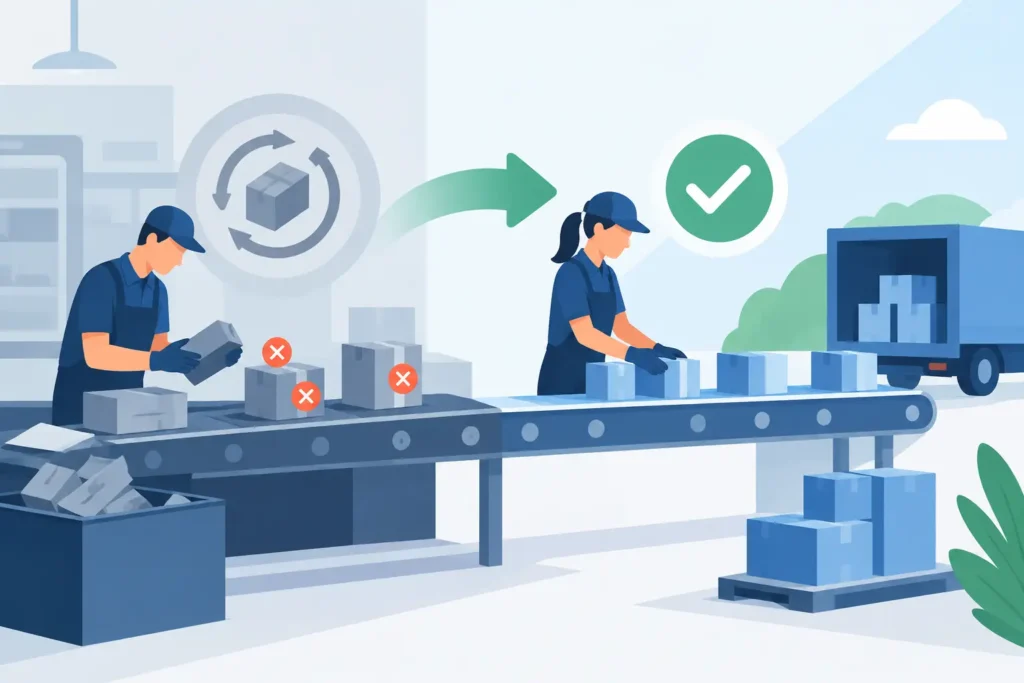
A sprint can look productive right up until the team starts reopening work it believed was finished. Engineering revisits a workflow because a key rule was never agreed. QA finds an edge case that should have been in the acceptance criteria. A stakeholder sees the released feature and says it is not what they meant. If you are asking how to reduce product rework, start by treating those events as delivery signals, not isolated mistakes.
Rework is expensive because it consumes the same people needed to move the roadmap forward. It also damages confidence. Teams stop trusting estimates because supposedly completed work keeps returning. Stakeholders escalate because they do not know when decisions are final. Product managers become message relays instead of owners of a clear delivery process.
The answer is not more ceremony or a larger backlog. Rework falls when the team makes decisions earlier, records them clearly, and tests assumptions before implementation becomes the most expensive way to learn.
Find the rework hiding in your delivery data
Most organizations undercount rework. They see bugs, support tickets, and failed releases, but miss the work quietly added to an active ticket: revised designs, clarification calls, unplanned integration effort, copied acceptance criteria, and stories returned from QA.
Start with the previous two or three releases. For each item that slipped, was reopened, or required substantial unplanned effort, ask one practical question: what did the team learn too late? The answer usually falls into one of four categories:
- The business outcome or priority changed after build work began.
- The requirement was ambiguous, incomplete, or assumed rather than confirmed.
- A technical, legal, security, operational, or supplier dependency surfaced late.
- The release was not validated against real user behavior or production conditions.
This is not an exercise in blaming the person who wrote the ticket. A poorly defined story is often evidence of an upstream decision that never had an owner. In multi-market products, for example, a simple promotional flow may also need market-specific terms, payment constraints, CRM behavior, SEO rules, and compliance approval. If those needs arrive during QA, the product team did not have a QA problem. It had a planning and decision problem.
Measure the pattern in plain language. Track reopened items, work added after sprint commitment, defects caused by missed acceptance criteria, and the share of releases requiring immediate follow-up fixes. You do not need a perfect taxonomy on day one. You need enough evidence to identify where the handoff breaks down.
How to reduce product rework before development starts
The highest-leverage change is to make work ready before it enters a sprint or delivery commitment. Ready does not mean every detail is predetermined. It means the team has enough shared understanding to build, test, and release without rediscovering the basic problem halfway through.
Give every item a decision owner
A ticket cannot be the place where competing stakeholders negotiate the product. Before development starts, someone must own the calls on scope, priority, and acceptable trade-offs. Usually that is the Product Owner or product lead, with explicit input from the people responsible for commercial, technical, legal, and customer outcomes.
Write down the decision, not just the discussion. For a feature that changes an affiliate conversion path, document the target user, the commercial objective, the expected behavior, the exclusions, and who approved the final scope. If a stakeholder later requests a change, it can be assessed as a new decision with a cost, rather than quietly inserted into work already underway.
This matters most when speed is under pressure. Without a named owner, teams confuse responsiveness with agreeing to every request. The result is scope churn disguised as collaboration.
Replace vague requirements with testable behavior
“Users should be able to manage preferences” is not ready for development. It leaves unanswered questions about which preferences, where they are stored, what consent means, what happens for existing users, and how success will be measured.
A useful requirement describes observable behavior and boundaries. It should state what the user can do, what the system must do, what must not happen, and how the team will know it works. Acceptance criteria are not a formality for the end of the process. They are the working agreement that allows product, engineering, design, and QA to spot different interpretations before code is written.
Keep the level of detail proportionate to risk. A low-impact copy change does not need a workshop. A change involving payments, user identity, regulated content, or a third-party integration should have more explicit scenarios and owners. Over-specifying simple work creates drag. Under-specifying high-risk work creates rework.
Run a short three-way check before commitment
A practical pre-build conversation between product, engineering, and QA catches a large share of avoidable rework. Design should join when the experience is nontrivial, and relevant specialists should join when there are compliance, content, security, data, or supplier implications.
The conversation should test feasibility, ambiguity, test approach, dependencies, and release risks. It is not a status meeting. The goal is to leave with a shared view of what will be built and what still needs a decision.
If the team discovers material unknowns, do not force the item into the sprint because it appeared on a roadmap. Split it, run a technical spike, validate the assumption, or move it behind better-understood work. That is not delay. It is choosing a cheaper learning method than rebuilding a feature later.
Stop mid-sprint changes from becoming invisible scope
Some change is legitimate. A production issue may require immediate attention. A legal interpretation may change. An experiment may show that the original hypothesis was wrong. The problem is not change itself. The problem is pretending it has no effect on capacity, delivery dates, or other commitments.
Establish a visible rule: any meaningful change to committed work requires a trade-off. Something is added, removed, delayed, or explicitly accepted as an increase in risk. The product lead should own the decision and make it visible to the people affected.
This changes the conversation. Instead of engineering absorbing requests through direct messages, stakeholders see the operational cost. Instead of the team being judged against an outdated sprint plan, leaders can make a deliberate choice about what matters now.
For remote-first teams, written decisions are especially valuable. A short decision log can capture the issue, options considered, owner, chosen path, and effect on scope or timing. It prevents the same debate from resurfacing in a different meeting two weeks later.
Build quality into the release path
A feature can meet the ticket criteria and still create rework after release. That happens when teams validate the local behavior but not the full customer or operational journey.
Definition of Done should therefore include more than merged code and passed tests. For the work that warrants it, it should cover analytics, monitoring, support readiness, content, rollback expectations, documentation, and ownership after release. The exact checklist should vary. A global event registration flow has different release risks from a back-office configuration change. The standard is not identical process. The standard is explicit readiness for the risk involved.
Release small enough to learn. Feature flags, phased rollouts, controlled market launches, and monitored experiments can reduce the blast radius of a wrong assumption. They also reveal whether the product outcome happened, rather than merely confirming that a release completed.
When an issue does occur, run a short review while the facts are fresh. Focus on the earliest point where the team could have known more. If QA found a missing rule, was the criterion absent? If a dependency failed, was it visible on the delivery plan? If stakeholders rejected the result, did anyone approve the intended behavior before build began? Turn the answer into one process adjustment, not a long list of actions nobody owns.
Make predictable delivery the operating standard
Reducing rework is not about making teams cautious or slowing them down with approvals. It is about protecting their time for work that creates value. The best product organizations make uncertainty visible early, put decisions in the hands of accountable owners, and refuse to hide scope changes inside delivery.
If reopened tickets, last-minute clarifications, and release fixes are common, start with one upcoming initiative. Define the decision owner, test the acceptance criteria with engineering and QA, map the dependencies, and agree on what can change after commitment. A cleaner delivery rhythm is built one explicit decision at a time.
Written by Veljko Barnić
Product Owner and delivery consultant in Belgrade. Six years leading end-to-end delivery for affiliate and iGaming platforms, and open to Head of Product, Head of Delivery and senior product roles.
More on delivery

Fractional Product Owner vs Consultant Explained
Compare a fractional product owner vs consultant to identify the support your team needs for backlog control, decisions, delivery cadence, and releases.
Read the article
When Fractional Product Services Actually Work
Fractional product services give stalled teams senior ownership, clear priorities, accountable decisions, and reliable releases without a full-time hire.
Read the article
How to Rescue Delayed Releases Without Panic
Learn how to rescue delayed releases by resetting scope, decisions, testing, and ownership - then build a delivery cadence that keeps next date credible.
Read the articleSomething isn't shipping. Let's find out why.
Send me three sentences about what's stuck, or take the free 30-minute call. Either way you'll get an honest read - including if the answer is that you don't need me.