

Top Causes of Failed Releases and How to Stop Them
Learn the top causes of failed releases, from unclear scope to weak ownership, and build a release process your teams can reliably deliver every quarter.

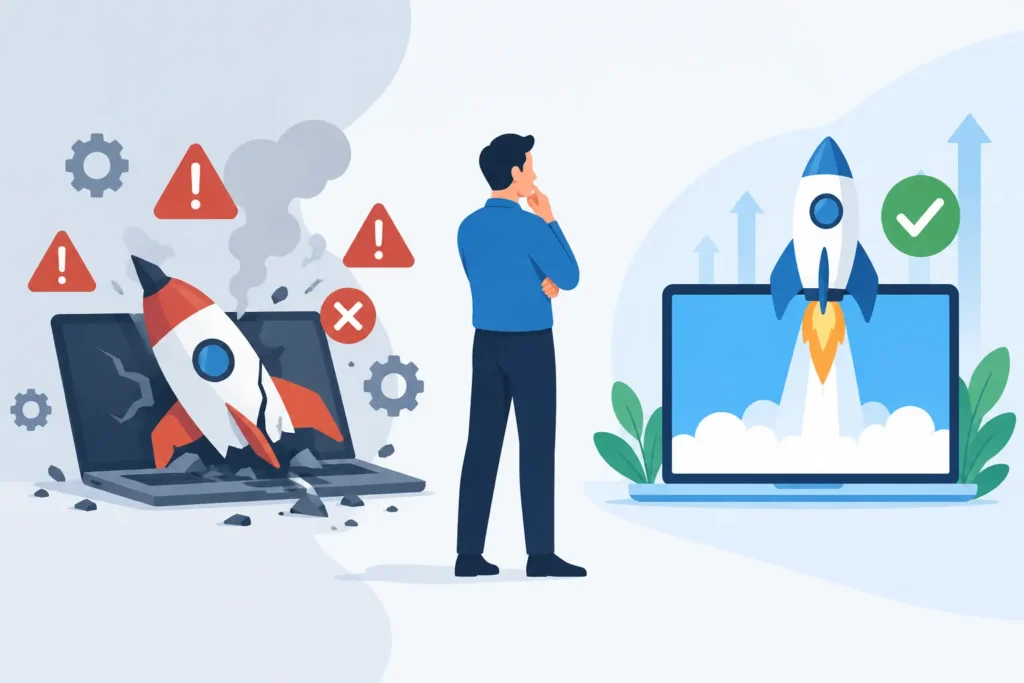
A release rarely fails because one engineer made one mistake on release day. It fails because the team has been carrying unresolved decisions, unclear scope, and hidden dependencies for weeks. The top causes of failed releases are usually visible well before deployment. The problem is that nobody has clear ownership to stop the release, narrow it, or make the trade-off explicit.
For product leaders, a failed release is more than a technical incident. It damages confidence in the roadmap, creates avoidable work for support and QA, and teaches stakeholders that delivery dates are not commitments. The answer is not more ceremony or a larger status meeting. It is a release process with decision rights, evidence, and a shared definition of what ready actually means.
The top causes of failed releases
Scope is still moving when delivery should be converging
A release cannot become predictable if its scope remains negotiable until the final days. This often starts with a reasonable request: a commercial stakeholder needs one more placement, compliance needs updated wording, or a customer-facing team identifies a missing edge case. Each request may be valid. Taken together, they turn a planned release into an uncontrolled bundle of changes.
The warning sign is language such as “it is only a small change” or “we can fit this in.” Small changes are rarely small in a multi-market product. A new payment rule can affect onboarding, reporting, support documentation, analytics, and QA. A content change on an affiliate product can alter SEO behavior or supplier commitments. The code change may be brief. The decision and verification work are not.
Set a clear scope freeze appropriate to the level of risk. That does not mean refusing every change. It means that every late change has an identified owner, a documented impact, and an explicit decision about what leaves the release to make room. If nothing leaves, the team is not prioritizing. It is accumulating risk.
Requirements describe features, not operational outcomes
Teams often begin development with requirements that sound complete but cannot be tested. “Show relevant offers,” “improve account verification,” or “support the new campaign” may communicate intent, but they do not define behavior across devices, markets, permissions, failure states, and reporting.
This is where late surprises come from. QA discovers that a user can bypass a rule. Legal sees an unapproved claim. Finance cannot reconcile a transaction state. Customer support has no explanation when a supplier response is delayed. None of these are edge cases if the business depends on them.
Good requirements do not need to become long documents. They need to make the outcome observable. Define the user, trigger, expected behavior, exceptions, data captured, and who accepts the result. For a regulated casino platform, that may include jurisdiction, player status, audit trail, and responsible-gaming constraints. For a global event brand, it may include time zones, inventory rules, localization, and customer communications. Context changes the detail required, but ambiguity creates the same outcome: rework late in the release cycle.
Dependencies are discovered instead of managed
Most digital releases involve work outside the immediate product and engineering team. Security may need to review a new integration. A payment provider may need configuration changes. Content, CRM, SEO, suppliers, data, or legal may each have a release-critical contribution.
The failure is not having dependencies. The failure is treating them as background activity. When a dependency has no named owner, no due date, and no verification point, it becomes a release-day surprise.
A practical release plan identifies dependencies early and makes their status visible alongside product work. For each one, capture what is needed, who owns it, when it is needed, and what happens if it is late. This is especially important when external parties are involved. Your sprint board cannot control a supplier’s lead time, but it can make the risk visible while there is still time to change scope or sequencing.
Estimates are mistaken for commitments
An estimate is a forecast based on what the team knows now. A commitment is a decision to deliver a defined outcome under agreed conditions. Confusing the two produces optimistic roadmaps and defensive delivery conversations.
A team may estimate a feature at two weeks, then uncover legacy constraints, incomplete data, or a missing API contract. That is not automatically poor performance. The real failure happens when no one revisits the release plan after the uncertainty becomes known. The date remains on a slide while the delivery reality changes underneath it.
Use estimates to expose uncertainty, not to hide it. Break down work early enough to find the unknowns. Track confidence separately from effort. If an item has significant technical, regulatory, or partner uncertainty, plan discovery before promising a release date. Leaders do not need false certainty. They need an early, credible view of what could change and the choices available.
There is no real definition of done
“Development complete” is not a release status. Neither is “QA passed” if QA tested only the happy path in a staging environment that does not reflect production.
A useful definition of done covers the work needed to operate the change, not merely build it. Depending on the product, that includes acceptance criteria, automated and manual testing, analytics validation, monitoring, support readiness, documentation, security review, rollback steps, and stakeholder sign-off. Not every release needs every activity at the same depth. A copy update and a new payment flow should not carry identical controls. Risk should determine the level of rigor.
The key is consistency. If teams use different meanings of done from one release to the next, leadership cannot trust the reporting. Establish a baseline, then agree on exceptions before work begins. Skipping a control can be a valid trade-off. Pretending it was never required is how a known risk becomes an incident.
Release ownership is shared so widely that nobody owns it
Cross-functional delivery requires collaboration. It does not require collective ambiguity. When a release is late or unsafe, teams often say that everyone was involved. That usually means no one had the authority to decide whether the release was ready.
Assign one accountable release owner. This person does not personally complete every task or override technical expertise. They coordinate the readiness view, surface gaps, obtain decisions, and make sure a go or no-go call happens at the right time. Engineering owns technical quality. Product owns scope and intended outcome. QA owns test evidence. But someone must connect those inputs into a release decision.
The same rule applies to approvals. If security, legal, or commercial sign-off is required, name the approver and the decision deadline. An approval that arrives after deployment is not governance. It is paperwork.
A release process that earns confidence
The goal is not to make every release slow. It is to match control to risk while keeping decisions close to the work. A low-risk configuration change may need a lightweight checklist and monitoring. A release involving customer funds, personal data, or regulatory exposure needs deeper review and a tested rollback path.
Start release planning when the work enters the delivery horizon, not when it enters QA. Identify the release objective, scope boundary, dependencies, risks, owners, and acceptance evidence. Revisit these in a short, disciplined readiness review as the date approaches. The meeting should answer practical questions: What changed? What is not ready? Who is deciding? What is the fallback?
Then separate readiness from optimism. If a release is not ready, there are only a few honest choices: delay it, reduce scope, accept a stated risk, or change the delivery approach. Each choice has a cost. The value of a disciplined process is that the cost becomes visible before customers find it for you.
After release, review the result while the evidence is fresh. Did the release achieve the expected business outcome? Did monitoring catch issues quickly? Which dependencies arrived late? What work appeared after scope freeze? This is not a blame exercise. It is how a team turns a painful release into a better operating model.
Predictable releases are built from ordinary habits: clear scope, named owners, testable outcomes, visible dependencies, and decisions made before the deadline forces them. If your team repeatedly misses releases, do not start by asking people to work harder. Start by asking which decisions are arriving too late, and who has the authority to make them earlier.
Written by Veljko Barnić
Product Owner and delivery consultant in Belgrade. Six years leading end-to-end delivery for affiliate and iGaming platforms, and open to Head of Product, Head of Delivery and senior product roles.
More on delivery

Fractional Product Owner vs Consultant Explained
Compare a fractional product owner vs consultant to identify the support your team needs for backlog control, decisions, delivery cadence, and releases.
Read the article
How to Reduce Product Rework Without Slowing Delivery
Learn how to reduce product rework by fixing unclear decisions, weak discovery, and release gaps before they turn into expensive delivery churn at scale.
Read the article
When Fractional Product Services Actually Work
Fractional product services give stalled teams senior ownership, clear priorities, accountable decisions, and reliable releases without a full-time hire.
Read the articleSomething isn't shipping. Let's find out why.
Send me three sentences about what's stuck, or take the free 30-minute call. Either way you'll get an honest read - including if the answer is that you don't need me.