

Why Your Product Roadmap Keeps Slipping Again
When your product roadmap keeps slipping, the cause is effort. Find the decisions, backlog gaps, and release controls that restore predictable delivery.

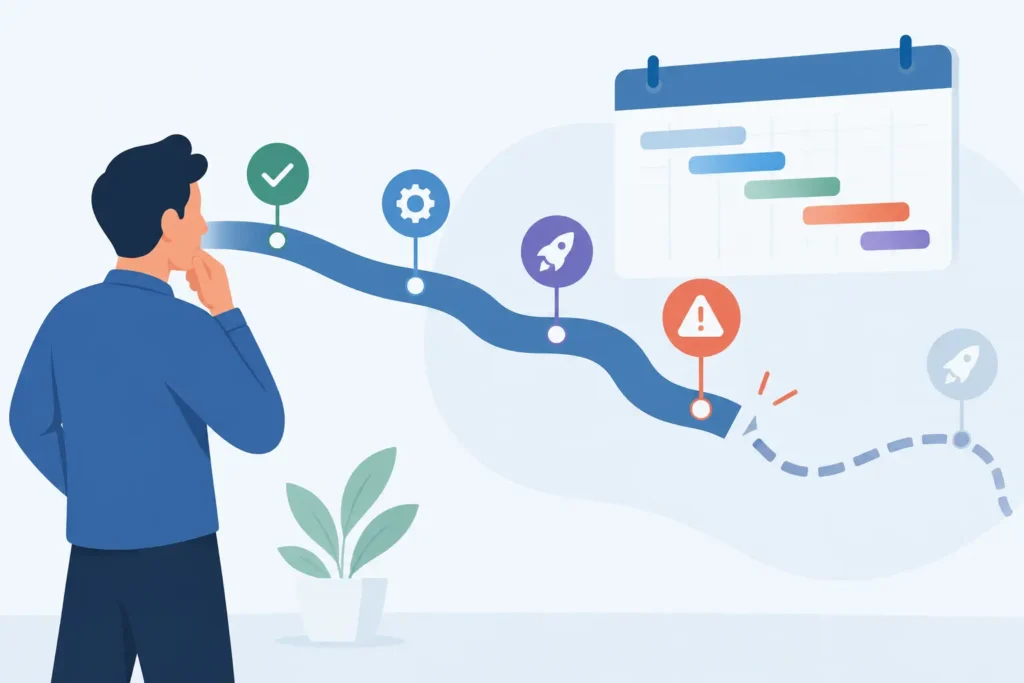
A roadmap date misses, so the team works later, adds another status meeting, and revises the estimate. Then it misses again. When your product roadmap keeps slipping, the cause is usually not a lack of effort. It is that work entered delivery without enough decisions made, enough scope understood, or enough capacity protected.
That distinction matters. A team cannot recover predictability by trying harder against an unreliable plan. Leaders need to identify where commitments are becoming fictional, then change the operating conditions around them.
A roadmap is a commitment system, not a feature list
Most slipping roadmaps start with a reasonable business request: launch in a new market, improve conversion, meet a regulatory deadline, replace a supplier, or close a competitive gap. The failure happens when the request is treated as a delivery commitment before the organization has agreed on what must actually be delivered.
A roadmap date is only credible when the underlying work has a clear outcome, a ranked priority, an accountable decision-maker, and a realistic path through design, engineering, QA, compliance, release, and measurement. If any of those are missing, the date is a hope with a calendar invitation attached.
This is especially visible in multi-market products. A seemingly contained payment improvement may involve provider dependencies, fraud controls, localized content, legal review, customer support readiness, and analytics changes. Engineering may complete its part while the overall release is still not ready. Calling that an engineering delay hides the real problem.
The first slip often happens before development starts
Teams commonly label a roadmap item “in progress” while discovery and delivery are happening at the same time. That can be appropriate for a small, reversible experiment. It is dangerous for a business-critical release with external dependencies.
Look at the work that repeatedly carries over from sprint to sprint. Is it blocked by unanswered questions? Does the team have acceptance criteria that describe observable behavior, or broad statements such as “support new onboarding flow”? Has someone decided which edge cases are required for launch and which can wait?
Unresolved decisions create invisible scope. Engineers fill gaps with assumptions, QA finds inconsistencies later, and stakeholders rediscover requirements when they see a working build. None of this looks like a planning failure in a status report. It looks like “unexpected complexity.” Often, it was expected complexity that no one owned early enough.
Separate discovery confidence from delivery commitment
A useful operating rule is to stop giving one date to work that is still uncertain. Instead, distinguish between a target for validating the approach and a commitment for shipping a defined increment.
For example, a product team may aim to validate a new affiliate tracking integration this month. Once the provider behavior, event taxonomy, reporting needs, and failure modes are known, it can commit to a production release. This is not bureaucracy. It prevents commercial urgency from forcing the team to pretend uncertainty has disappeared.
The trade-off is that leaders may have to communicate less certainty earlier. That is preferable to communicating certainty early and failure late.
Why product roadmaps keep slipping: priority never really holds
A ranked backlog is not enough if priorities change through side channels. A founder messages an engineer. Sales promises a prospect a capability. Compliance introduces a late requirement. A key customer escalates directly to support. Each request may be valid. The problem is whether it displaces planned work explicitly.
When no one records the trade-off, the roadmap absorbs it silently. Teams start more work, finish less, and report that everything is important. The eventual slip is then presented as a capacity issue, even though the organization chose to spend capacity elsewhere.
A delivery owner should make the exchange visible: if this urgent request enters now, what leaves the release, moves to the next cycle, or receives less validation? There is no universal answer. A regulatory change may correctly override a growth feature. A contract renewal may deserve urgent attention. But someone with the right authority must make the choice and accept its consequence.
This is where senior product ownership earns its value. The role is not to protect a roadmap at all costs. It is to protect the integrity of decisions so that everyone understands what the roadmap now means.
Estimate the work you can see, expose the work you cannot
Unreliable estimates are often blamed on engineering teams, but the input to estimation is frequently incomplete. A two-week estimate for a feature may cover implementation only, while the release also needs product clarification, UX review, test data, content approval, security assessment, release coordination, and post-launch monitoring.
Do not force false precision. Use estimates to identify the conditions that could change the plan. For larger items, ask what must be true before the team can confidently start, what dependencies sit outside the squad, and what evidence will show the work is ready to release.
Historical delivery data helps, but only when compared honestly. If a team has completed six small backlog items per cycle for the last quarter, planning twelve because the quarter is commercially important is not ambition. It is an untested assumption.
Capacity also needs protecting. Planned work will not finish predictably if every cycle is consumed by production incidents, operational requests, and unplanned stakeholder work. Some environments need a deliberate allocation for those demands. The exact percentage depends on product maturity and risk, but pretending they do not exist guarantees bad forecasts.
Release readiness cannot be a final-week activity
Many teams use “done” to mean code merged. The business hears “done” as available to customers and capable of producing the intended result. The gap between those definitions is where release plans fail.
A workable definition of done reflects the product’s reality. For a regulated casino platform, it might include jurisdiction review, responsible gaming behavior, payment checks, and operational support instructions. For a global event product, it might include content readiness, traffic expectations, tracking validation, and incident coverage. The standard changes by context, but it must be agreed before delivery begins.
Release readiness should be checked as the work develops, not during a last-minute launch meeting. Product, engineering, QA, operations, and any control functions need a shared view of what remains. A short readiness review is useful when it answers real questions: what is incomplete, who owns it, what decision is needed, and what happens to the date if it is not resolved?
Replace status theater with decision-focused cadence
A weekly meeting where every team says “on track” does not improve delivery. It often delays bad news because people assume they need a complete answer before escalating a risk.
Use a regular cadence that separates progress from decisions. Progress can be visible in the delivery board, completed outcomes, and release readiness. Meeting time should focus on blocked decisions, dependency changes, scope trade-offs, and risks that need an owner.
For each roadmap initiative, keep the reporting simple: the intended outcome, current delivery confidence, the next decision, and the owner of that decision. If confidence drops, say why in plain language. “Pending legal review” is more useful than “amber.” “Supplier API behavior is inconsistent in production” is more useful than “technical risk.”
This approach creates accountability without turning teams into reporting machines. It also gives executives an earlier chance to choose between scope, time, cost, and risk rather than discovering the choice after the date has already failed.
Run a recovery plan without creating more chaos
Once a roadmap is slipping, the instinct is to add people, extend hours, or split the work into smaller tickets. Those actions sometimes help, but they do not fix unclear scope or unresolved dependencies. Adding people to a late effort can increase coordination costs and slow decisions further.
Start with a brief delivery reset. Confirm the outcome the business needs, identify the smallest release that can meet it, map the remaining blockers, and assign an owner and decision deadline to each one. Then remove work that does not serve the immediate outcome.
The reset needs executive backing. If stakeholders can still inject requests without accepting trade-offs, the team will return to the same conditions that caused the slip. If leaders want an earlier date, they must decide what certainty, scope, or risk they are willing to give up.
A predictable roadmap is not one that never changes. Markets change, incidents happen, and new information should alter plans. It is one where changes are made deliberately, their cost is visible, and the team is allowed to finish what the business has chosen. Start by asking which decision your team has been postponing. That answer is often more useful than another revised date.
Written by Veljko Barnić
Product Owner and delivery consultant in Belgrade. Six years leading end-to-end delivery for affiliate and iGaming platforms, and open to Head of Product, Head of Delivery and senior product roles.
More on delivery

Product Discovery Process Guide for Teams That Ship
This product discovery process guide shows product leaders how to turn uncertain ideas into tested, decision-ready work before delivery begins with less risk.
Read the article
Refinement (Grooming) That Gets Teams Shipping
Refinement (grooming) turns a crowded backlog into decisions, usable work, and dependable releases. Learn how product leaders run it with accountability.
Read the article
How to Plan Product Capacity Without Missing Dates
Learn how to plan product capacity using real delivery data, explicit trade-offs, and clear ownership to make roadmaps and releases credible and reliable.
Read the articleSomething isn't shipping. Let's find out why.
Send me three sentences about what's stuck, or take the free 30-minute call. Either way you'll get an honest read - including if the answer is that you don't need me.