

How to Reduce Product Delivery Risk Before Release
Learn how to reduce product delivery risk by clarifying decisions, controlling scope, and building release confidence across product and engineering teams.

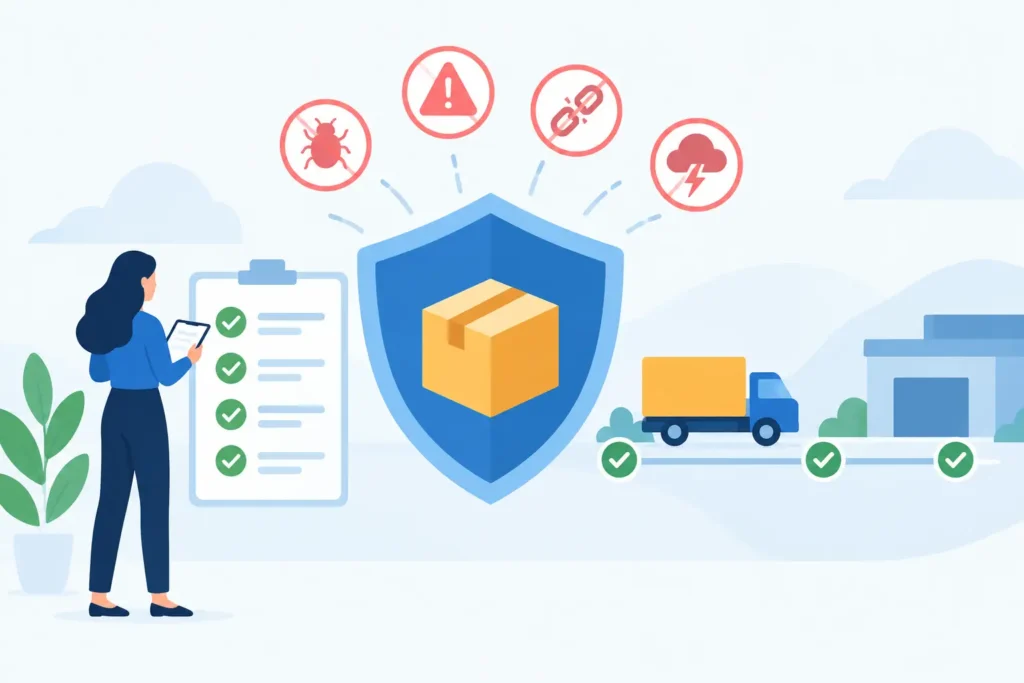
A release rarely becomes risky in the final week. The final week is simply when everyone can see the consequences of earlier decisions: a vague requirement, a dependency nobody owned, a late compliance review, or a scope change treated as harmless. To reduce product delivery risk, fix the conditions that allow uncertain work to enter the delivery system in the first place.
For product leaders, this is not an argument for more ceremony or slower teams. It is an argument for making commitments that mean something. A team can move quickly and still be predictable when priorities are explicit, decisions have owners, and release readiness is tested before the calendar creates pressure.
Product Delivery Risk Starts Before Development
Delivery risk is often described as an engineering problem because it becomes visible as missed estimates, defects, failed deployments, or delayed releases. Those are real problems, but they are usually downstream symptoms.
The earlier signals are more familiar: the backlog contains work that has not been challenged against current business goals; stakeholders disagree on what success means; design, content, legal, security, payments, or SEO are brought in after development starts; and teams are asked for dates before anyone has defined the work well enough to discuss its trade-offs.
In a multi-market platform, a small product change may touch localization, payment behavior, supplier data, age-gating, consent, or market-specific compliance. Calling it a "simple UI change" does not make those dependencies disappear. It only ensures they surface late, when options are limited and the cost of changing direction is higher.
The goal is not to eliminate uncertainty. Product work contains uncertainty by definition. The goal is to expose it early, decide what must be learned, and avoid presenting guesses as delivery commitments.
Separate uncertainty from complexity
A technically complex item can still be low risk if the team understands the architecture, has completed similar work before, and has clear acceptance criteria. A seemingly small item can be high risk when the expected customer behavior is unknown or a third party controls a critical dependency.
Treat these differently. Complexity may need decomposition, technical discovery, or additional engineering capacity. Uncertainty may need research, a prototype, an experiment, or a stakeholder decision. Putting both into a sprint as a normal delivery item hides the work required to make a credible forecast.
Put One Owner Behind Every Decision
The most expensive delivery delays are often decision delays. A team finishes its work, then waits for someone to choose a market, approve messaging, confirm a legal interpretation, or settle a disagreement between commercial stakeholders.
A decision does not have an owner because someone attended a meeting. It has an owner when one named person is accountable for making the call by a known date, using agreed input. Product should make that visible rather than quietly carrying unresolved conflict into the next planning cycle.
For each meaningful initiative, establish the intended outcome, the decision-maker, the delivery owner, and the people who must be consulted before implementation begins. This does not require a heavy governance document. A short decision log is usually enough, provided it is current and used.
There is a trade-off here. Bringing every stakeholder into every decision slows delivery. Excluding required specialists creates rework. The practical answer is to involve people based on the type of risk, not hierarchy. A security lead needs early involvement when authentication or personal data changes. They do not need to review routine content placement.
Make Scope Small Enough to Be True
Teams do not miss commitments only because they underestimate effort. They also make commitments at the wrong level of abstraction. "Launch the new affiliate onboarding flow" can conceal tracking changes, content production, partner approvals, reporting requirements, localization, and CRM behavior. It is an initiative, not a delivery unit.
Break initiatives into increments that can be independently understood, tested, and released. The first increment should answer a meaningful business or technical question, not merely produce internal activity. For example, a new onboarding experience might first support one market, one acquisition channel, and one payment path. That can reveal conversion behavior and operational gaps without committing the organization to a broad rollout.
Smaller scope is not automatically better. Splitting a change too aggressively can produce fragmented customer experiences or duplicate technical work. The test is whether each increment creates usable evidence and keeps critical dependencies manageable.
A healthy backlog makes this visible. Items should state the customer or business outcome, the boundaries of the work, acceptance criteria, dependencies, and open questions. If a team cannot explain what is out of scope, it is not ready to estimate responsibly.
Use a Cadence That Exposes Problems Early
Status reporting does not reduce risk when it only repeats that work is "on track." A useful delivery cadence forces the right conversations before a deadline is in danger.
Weekly delivery reviews should focus on movement and blockers: what changed since the last review, which assumptions were tested, what decision is now required, and whether the expected release scope still holds. If scope, timing, or quality has changed, say so directly. A late surprise is worse than an early escalation.
This is where product and engineering leadership need to work as partners. Product owns priority and outcome clarity. Engineering owns technical approach, feasibility, and quality risk. Neither can produce a reliable commitment alone.
Use evidence rather than optimism to update plans. Evidence includes completed discovery, validated designs, working integrations, test results, dependency confirmations, and actual throughput from comparable work. A percentage-complete estimate without these signals is usually theater.
For organizations working to OKRs or commercial targets, connect delivery reviews to those measures. If an experiment fails to improve the expected metric, the correct response may be to stop or reshape the initiative, not continue because it was placed on a quarterly roadmap. Delivery discipline includes stopping low-value work.
Treat Release Readiness as Product Work
A release is not ready because development is complete. It is ready when the organization can safely put the change in front of customers and respond if reality differs from the plan.
That means agreeing on the release path early. Will the feature be rolled out to everyone, a segment, or a single market? Is there a feature flag? What is the rollback condition? Who monitors customer impact, revenue signals, errors, support contacts, and partner behavior? What happens outside business hours?
For a regulated casino product, the release checklist may need compliance approval, responsible gaming checks, supplier confirmation, geo-specific restrictions, and audit evidence. For a global event brand, it may need content readiness, traffic expectations, ticketing or registration dependencies, and support coverage. The format differs, but the operating principle is the same: release criteria must reflect the real operating environment.
Do not turn this into a generic checklist copied from another company. A checklist earns its place when it reflects recurring failure modes. If payment failures have delayed three recent releases, payment validation needs a named owner and a defined point in the workflow. If content arrives late every time, the plan must show content as a dependency rather than assuming it will appear.
Reduce Product Delivery Risk With Clear Commitments
The strongest delivery teams do not promise certainty they do not have. They make the next commitment clear, bounded, and accountable. They distinguish between a target date and a confirmed release date. They show what needs to happen for confidence to increase. And when a trade-off is required, they bring options to the decision-maker instead of silently absorbing the cost.
This is especially important when a roadmap has slipped repeatedly. The instinct is often to add more work: more planning meetings, more reporting, more people in approval chains. First, inspect the flow of decisions and work. Find where items wait, where requirements change, where dependencies enter too late, and where nobody is empowered to resolve conflict.
A delivery audit can be useful when the organization has lost confidence in its own plans, but the value is not the document. The value is a practical reset: ranked work, clear owners, a credible release path, and a cadence that makes risk visible while there is still time to act.
The next planning conversation does not need to solve the whole roadmap. Start with the nearest meaningful release. Ask what must be true for customers to receive it safely, who owns each unresolved decision, and what evidence is missing. A smaller, honest commitment is the fastest way to rebuild delivery trust.
Written by Veljko Barnić
Product Owner and delivery consultant in Belgrade. Six years leading end-to-end delivery for affiliate and iGaming platforms, and open to Head of Product, Head of Delivery and senior product roles.
More on delivery

Product Discovery Process Guide for Teams That Ship
This product discovery process guide shows product leaders how to turn uncertain ideas into tested, decision-ready work before delivery begins with less risk.
Read the article
Refinement (Grooming) That Gets Teams Shipping
Refinement (grooming) turns a crowded backlog into decisions, usable work, and dependable releases. Learn how product leaders run it with accountability.
Read the article
How to Plan Product Capacity Without Missing Dates
Learn how to plan product capacity using real delivery data, explicit trade-offs, and clear ownership to make roadmaps and releases credible and reliable.
Read the articleSomething isn't shipping. Let's find out why.
Send me three sentences about what's stuck, or take the free 30-minute call. Either way you'll get an honest read - including if the answer is that you don't need me.